Great Machine United’s United Vitalis faces a well-known technical problem: medicine today often treats disease too late, at high cost, and with limited reach. Genetic disorders, organ shortages and age-related decline impose large human and economic burdens. Meanwhile, the underlying science has matured. Gene editing, stem-cell engineering and 3D bioprinting now promise durable cures and regenerative outcomes. Yet translating those tools into safe, equitable, and scalable products remains complex.
United Vitalis addresses these challenges by combining three forces. First, it uses Gabriel AI and specialised biomedical subnets to turn massive clinical and biological datasets into validated therapeutic hypotheses. Second, it deploys modular manufacturing, regional biobanks and certified clinical networks to shorten delivery timelines. Third, it embeds governance, data sovereignty and ethical review into every engineering step. This article explains United Vitalis’s architecture, data inputs, compute stack, translational pipeline and safeguards. It aims to be technically detailed while avoiding operational laboratory protocols or procedural instructions.
The technical constraints: what blocks genetic medicine at scale
Several engineering and regulatory bottlenecks slow progress:
• Biological heterogeneity. Populations vary genetically. That variability changes drug responses and correction outcomes.
• Predictive uncertainty. Off-target effects and complex gene–environment interactions can produce unexpected outcomes.
• Manufacturing scale. Producing cell and gene therapies requires tightly controlled GMP facilities, often costly and centralised.
• Distribution friction. Cold chains, specialised clinicians and complex consent frameworks hamper rollout in remote regions.
• Governance and ethics. Germline alteration and enhancement raise social and regulatory objections that must be addressed robustly.
United Vitalis designs systems to reduce each constraint while staying within legal and ethical boundaries.
Data foundation and model ecology
At the heart of United Vitalis sits Gabriel AI’s biomedical cluster. The platform supports federated, auditable, and privacy-preserving workflows.
Key data inputs include:
• De-identified genomic cohorts that represent global allele frequencies and admixed populations.
• Longitudinal clinical records and imaging from consenting hospital partners.
• Multi-omic panels (transcriptomics, proteomics, metabolomics) linked to phenotype registries.
• Biosensor streams from wearables and implantables for real-time physiological context.
• Controlled environmental and socioeconomic metadata to model gene–environment interactions.
For model governance, United Vitalis applies a layered approach. First, federated learning trains models on local nodes so raw data never leaves sovereign boundaries. Second, differential privacy and homomorphic encryption protect outputs. Third, a signed model registry stores model versions with provenance metadata and test suites. Teams only release models that pass safety and bias audits.
Gabriel AI runs on an NVLink-backed GPU fabric within GMU datacentres and hybrid edge nodes. This architecture supports large molecular transformer models for protein design, multi-scale immunological simulators, and accelerated virtual-patient cohorts used in adaptive trial planning. The stack integrates reproducible pipelines, SBOMs for software artifacts, and SLSA-style attestations for regulatory traceability.
Genetic correction and enhancement: principled pathways, not shortcuts
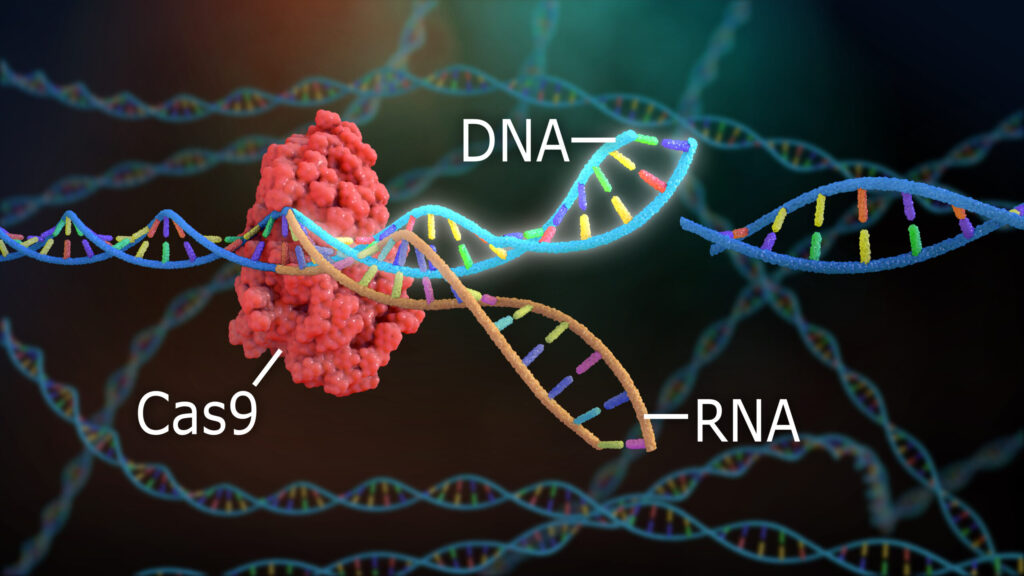
United Vitalis pursues genetic correction strategies that prioritise somatic interventions. The company explicitly excludes clinical deployment of heritable germline editing except in tightly regulated, research-only contexts where sovereign regulators permit oversight and public consent.
For somatic correction, United Vitalis combines in-silico target validation with orthogonal experimental verification. Gabriel AI helps identify candidate targets and predict immunogenicity and off-target risk at scale. However, United Vitalis requires independent wet-lab confirmation and regulated preclinical studies before any human use.
Enhancement work remains strictly bounded by policy. Under Vision 64, United Vitalis supports limited, reversible, and therapeutically minded enhancements only where regulators and communities approve. For example, interventions that restore lost function—such as sight restoration or muscular rehabilitation—receive priority. The company publishes policy impact analyses and convenes public fora before any enhancement pilot.
Stem cell systems and biobanking: vaults for regenerative readiness

United Vitalis operates a distributed stem-cell banking network certified to GMP and ISO standards. These banks store characterised iPSC lines, validated mesenchymal progenitors and tissue-specific organoids under controlled cryopreservation.
The engineering focus includes:
• Standardised annotation and metadata for each line, enabling reproducible downstream workflows.
• Traceable consent frameworks linking donors, use cases and benefit-sharing commitments.
• Rapid regional access via micro-manufacturing hubs to cut the time from thaw to clinic.
Critically, United Vitalis uses digital twins and continuous digital QA to maintain global quality parity across sites. These twins emulate manufacturing runs to reduce variance and to stress-test release criteria in silico. The use of digital twins aligns with regulatory expectations for continuous manufacturing oversight.
Synthetic organs and 3D-bioprinting: solving vascularisation and integration
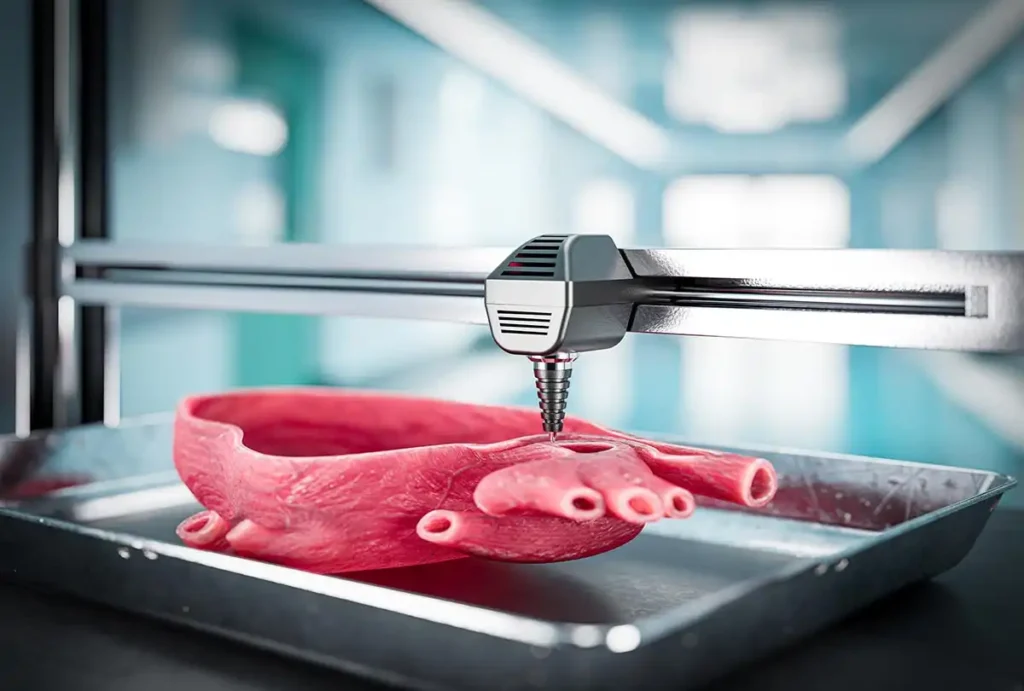
Synthetic organ manufacture remains one of the field’s toughest engineering problems. United Vitalis approaches it as a systems challenge: scaffold design, cell sourcing, vascular integration and implant immunity must work together.
Key architectural elements include:
• Multi-material bioink platforms designed for mechanical match and cellular compatibility. Bioink formulations remain proprietary and regulated; United Vitalis publicises material classes and performance targets rather than recipes.
• Perfusable vascular scaffolds modelled using computational fluid dynamics (CFD) and validated with microfluidic assays. Gabriel AI optimises vascular architectures by simulating shear, oxygen diffusion, and nutrient gradients.
• On-board sensor arrays embedded into printed tissues to monitor viability and electrical function during maturation and after implant. These sensors feed encrypted telemetry to local inference nodes for early warning of dysfunction.
• Immune-modulation strategies aimed at promoting integration without chronic immunosuppression, tested in controlled translational models.
United Vitalis follows recognised device and tissue regulations (e.g. ISO 10993 biocompatibility guidance) and maintains GMP-equivalent cleanrooms for organ manufacture. The organisation works closely with transplant networks to evaluate clinical pathways and to design phased rollouts that prioritise high-need patients.
Longevity programmes: biomarkers, trials and measurable outcomes
United Vitalis’s longevity work rests on measurable biology. The company does not sell miracle cures. Instead, it pursues interventions that shift validated biomarkers of biological age and deliver clinically meaningful outcomes.
The approach blends:
• Composite biomarker panels that include epigenetic clocks, proteomic signatures, immune metrics, and metabolic health markers.
• Closed-loop intervention trials where adaptive dosing and lifestyle inputs refine regimens using edge inference and local clinician oversight.
• Post-market surveillance with registered outcome registries to document long-term benefits and harms.
Trials follow ICH-aligned adaptive designs and pre-register endpoints with regulators. The company emphasises clinical endpoints such as functional independence, disease incidence, and validated quality-of-life measures—rather than surrogate outcomes alone.
Manufacturing, distribution and Hashtag Coin (HTC) integration
United Vitalis reimagines the supply chain for biologics and cell therapies. The system couples decentralised manufacturing nodes with a tokenised ledger for procurement, capacity reservation and community incentives.
Key features:
• Regional modular GMP pods reduce cold-chain distances and enable rapid fill–finish near demand. These pods use standardised automation modules and digital twin validation to speed regulatory inspections.
• United Logistics coordinates drone delivery, refrigerated freight and mobile clinics. Delivery confirmations and quality checkpoints use zero-knowledge proofs to preserve privacy while enabling verification.
• HTC functions as a procurement and incentive instrument. Governments, NGOs and donors reserve slots by purchasing HTC-denominated credits. Local healthcare workers earn micro-rewards in HTC for verified care delivery, improving coverage and traceability.
United Vitalis integrates these flows with public auditing tools and with LME-linked attestations for HTC asset backing. Financial operations comply with international AML and payments regulations.
Safety, regulation and ethical governance
United Vitalis embeds safety and ethics into system design, not as an afterthought.
Governance mechanisms include:
• Independent ethics boards with multidisciplinary membership, including community representatives from partner regions.
• Transparent model audits and external performance validation by accredited labs.
• Regulatory alignment with ICH, GCP, GMP and device standards such as ISO 13485. United Vitalis engages early with regional regulators to co-design evidence packages.
• Privacy and sovereignty by design using federated analytics, differential privacy, and local data enclaves. The company supports national data residency where required.
Moreover, United Vitalis publishes redacted safety summaries, adapts outputs in response to public consultation, and funds local capacity building so partner systems can oversee their own health infrastructure.
Risk management and failure modes
United Vitalis recognises several risk classes and applies engineered mitigations.
- Biological risk: model miscalibration or rare off-target events. Mitigation: multi-layer validation, orthogonal assays, and phased, closely monitored clinical rollouts.
- Manufacturing risk: supply shocks or single-site failure. Mitigation: modular redundancy and multi-sourcing of critical inputs.
- Governance risk: policy drift or misuse. Mitigation: legally binding benefit-sharing terms, public reporting, and independent audit trails.
- Social risk: inequitable access or cultural concerns. Mitigation: community advisory boards, transparent consents, and local workforce development.
The organisation treats risk management as ongoing engineering, funded through dedicated reserves and HTC-backed contingency pools.
Partnerships, capacity building and Vision 64 alignment
United Vitalis does not operate alone. The programme partners with academic hospitals, regional regulators, and civil society organisations. It invests in skills transfer and in regional manufacturing capacity to avoid dependency.
Under Vision 64, United Vitalis commits to measurable milestones: increased regional manufacturing capacity, defined reductions in disease burden, and verified improvements in functional outcomes. The roadmap ties technological advances to social metrics, such as training slots, local employment and community benefit allocations.
Roadmap and closing perspective
In the near term, United Vitalis will expand its modular biomanufacturing network and validate additional adaptive formulations. Over the mid term, the company will scale stem-cell banks and accelerate regulated clinical pathways for organ scaffolds. Longer term, United Vitalis envisions integrated programmes where genetic correction, regenerative medicine and adaptive dosing converge into personalised, resilient healthcare systems accessible worldwide.
The promise is substantial: durable cures, fewer transplant waitlists, and longer healthy lifespan for many. Yet United Vitalis also recognises the moral weight of this work. Therefore the company pairs ambition with governance, transparency, and community partnership. By harnessing Gabriel AI’s predictive power, modular manufacturing, and a tokenised logistics layer, United Vitalis aims to make high-quality biotech accessible at planetary scale—while keeping safety, ethics and sovereignty at the centre of every step.