United Defence: Autonomous Protection for a Safer Tomorrow
Great Machine United (GMU) builds security around foresight, not force. Today’s battlespace moves faster than human decision cycles. Consequently, legacy command-and-control models cannot always protect dispersed infrastructure, supply chains, or vulnerable communities. To address this gap, United Defence combines Gabriel AI, advanced robotics, and resilient communications to offer predictive, proportional, and ethically governed protection at scale.
The problem: complexity, speed and scale outstrip legacy security
Modern security environments present three converging challenges. First, threats emerge faster than human teams can react, particularly in remote or hostile regions. Second, infrastructure — from mines and data centres to power grids and ports — now spans heterogeneous systems and suppliers, creating many single-point failures. Third, public expectations demand safety and transparency: communities expect protection without erosion of civil liberties.
Consequently, defenders must combine real-time situational awareness, rapid physical response and strict ethical governance. GMU solves this by integrating robotics, AI, secure tokenised logistics and human oversight into a single operational architecture.
GMU’s approach: an end-to-end, human-centred security stack
GMU builds defence capabilities around three core principles:
- Predictive foresight. Gabriel AI models threats using multimodal data — sensor feeds, socio-economic indicators and geospatial telemetry — to forecast incidents and prevent escalation.
- Autonomous precision. Autonomous systems perform the highest-risk tasks (route clearance, remote inspection, extraction), limiting human exposure while increasing operational tempo.
- Ethical governance. Every deployment undergoes Gabriel-powered ethical simulation, legal review and real-time audit trails to ensure compliance with international norms.
Below, we unpack the technical architecture and operational processes that power GMU’s Private Security Forces.
System architecture: components and data flows
GMU uses a layered architecture combining edge robotics, resilient networking, core AI and human mission control.
Core components
- Gabriel AI (Core): Neural superstructure for planning, simulation, and policy enforcement. Uses federated learning and model orchestration across NVLink-based GPU clusters and quantum-hardened key management.
- Edge compute nodes: Rugged Gabriel Edge Nodes (APU + tensor accelerator + FPGA) run ROS2-based autonomy stacks and provide sub-50ms inference for real-time control.
- Communications fabric: Deterministic networking via TSN for local clusters; ECMP and packet-level spraying across WAN links for high throughput and low jitter. LEO satellite and private 5G/6G provide resilient long-haul links.
- Security & cryptography: Zero-trust identity, PKI with post-quantum signatures, and zero-knowledge proof (ZKP) attestations for mission logs. Data integrity ties into Hashtag Coin (HTC) settlements for auditable supply-chain actions.
- Command & control (C2): A human-on-loop C2 portal built on microservices (Kubernetes, service mesh), DDS (OMG Data Distribution Service) for low-latency telemetry, and hardened UI for legal and ethical overrides.
Data inputs & telemetry
- Multispectral EO/IR satellite imagery
- LIDAR, radar and stereo vision from unmanned vehicles
- Seismic and acoustic sensor networks
- Logistics telemetry (haulage, supply chain)
- Socio-political indicators and open-source intelligence (OSINT)
Autonomous Ground Forces (AGF)
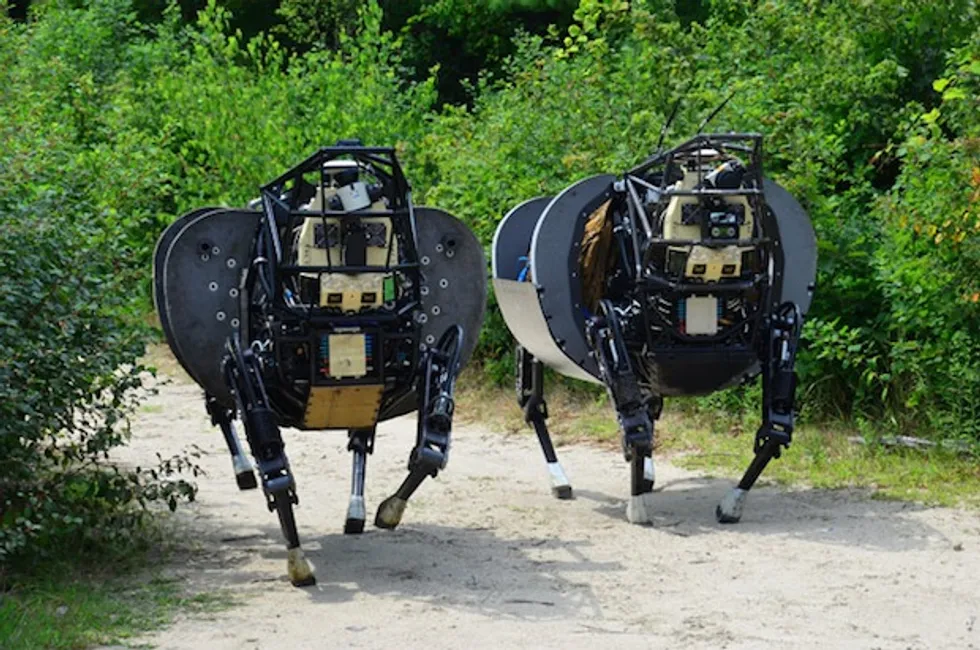
GMU’s AGF provide a non-escalatory protective presence for sites and convoys. Importantly, we design these systems for defensive and protective missions: deterrence, inspection, logistics escort and casualty evacuation.
Functional capabilities
- Perception & sensor fusion: LIDAR + radar + EO fusion, fused through a Kalman/particle-filter pipeline to produce robust tracks. Models run on tensor accelerators with NVLink interconnect for minimal latency.
- Motion & control stack: ROS2 navigation (nav2), real-time RTOS kernels and formal verification for safety-critical routines.
- Mission autonomy modes:
- Assistive mode — human drives; robot provides warnings.
- Supervised autonomy — robot executes constrained tasks under human approval.
- Autonomous support — robot performs pre-approved defensive tasks (area awareness, barrier deployment) with human veto.
- Interoperability: Conforms to STANAG-style messaging profiles for allied systems and supports Link-16-like situational windows (read-only) for coalition awareness.
Hardware & endurance
- Medium tracked and wheeled platforms with modular payload bays
- Redundant power systems and thermal management for harsh climates
- Swappable sensor & mission modules for rapid role changes (surveillance, medevac, engineering)
Peacekeeping operations: non-kinetic stabilisation at scale

GMU’s Peacekeeping Operations prioritise stability and civilian protection. We deploy mixed teams of human specialists, robots and Gabriel AI orchestration to augment UN and host-nation efforts.
Key services
- Population monitoring (privacy-preserving): Rather than persistent identification, GMU applies differential privacy and homomorphic techniques to extract pattern anomalies without exposing personal identities.
- Logistics and aid distribution: Smart contracts on HTC automate transparent distribution of supplies; local partners confirm receipts via ZKP.
- Conflict de-escalation tools: Real-time mediation dashboards, AI-suggested non-violent interventions and trusted human negotiators coordinate response.
Standards & partnerships
GMU works with humanitarian standards (Sphere, Do No Harm) and regional bodies to ensure operations remain legal, accountable and community-led.
Urban Surveillance Grids: safe cities, explained
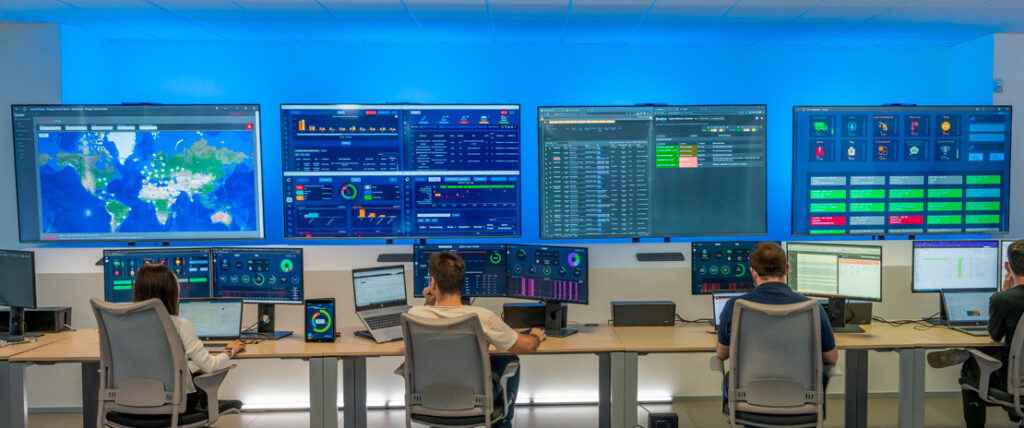
GMU integrates city-scale monitoring with privacy safeguards and human oversight. The aim is continuous situational awareness for resilience — not mass surveillance.
Architectural highlights
- Mesh of edge analytics: Cameras, acoustic sensors and air-quality nodes stream anonymised features to local Gabriel Edge clusters.
- Federated learning: Instead of centralising raw footage, edge nodes train local models; federated updates merge into Gabriel’s global model, preserving citizen privacy.
- Explainability & audit: Every alert includes an explainable trace (model inputs, confidence, counterfactuals) and an immutable log anchored via HTC for audits.
Use cases
- Rapid detection of infrastructure damage (bridges, substations)
- Crowd-management during mass events with non-invasive, anonymised flow analytics
- Environmental hazard alerts (chemical leaks, fires) integrated with municipal response teams
Hostile-Environment Extraction: rescue when it matters most
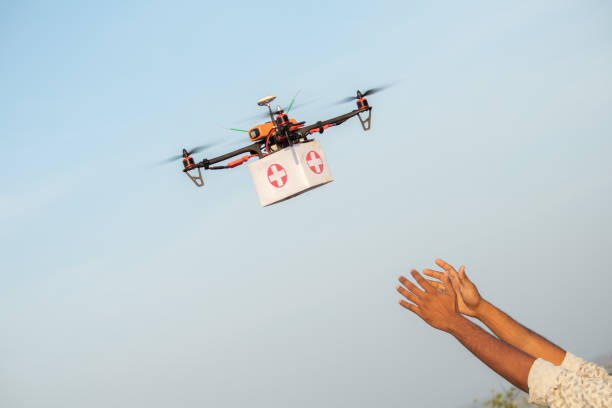
When disaster or conflict creates life-threatening conditions, GMU deploys drone and tethered-bot systems that perform extraction, medical triage and supply delivery.
System elements
- Aerial swarm autonomy: Small VTOL drones operate in coordinated swarms. Mission orchestration uses behaviour trees and Gabriel AI’s global planner for collision-free ingress/egress.
- Tethered lifeline robots: For deep mines and collapsed structures, tethered units provide power and comms to remote teams.
- Low-latency teleoperation: Haptic-enhanced remote control uses edge inference and 5G/LEO links, with local autonomy fallback during comms loss.
Safety & throughput
- Redundant sensor suites with automatic safe-stop routines
- Priority channeling for medevac traffic via deterministic networking (TSN)
- Integration with local hospitals and medevac protocols for rapid handover
Security, resilience and verification
GMU builds defence systems with multi-layered assurance.
- Cryptographic backbone: Post-quantum key exchange, layered PKI and hardware root of trust (TPM/SE).
- Operational resilience: ECMP routing and packet-spraying mitigate single-link failures. Containerised services respawn automatically via Kubernetes operators.
- Software assurance: Continuous integration with formal verification for safety critical modules, and CI/CD pipelines that run adversarial robustness tests.
- Auditability: All mission events cryptographically timestamp to HTC-anchored ledgers. ZKPs allow proof of action without exposing sensitive data.
Ethical guardrails and governance
GMU recognises that legitimacy requires more than capability. Therefore:
- Human-in/over-the-loop policy: Humans retain final authority for any kinetic or escalation decision. Autonomous systems perform only predefined defensive tasks.
- Gabriel-powered ethical simulations: Before deployment, scenarios run through Gabriel’s counterfactual engine to model long-term social and legal outcomes.
- Independent oversight: GMU funds independent audit panels — ethicists, legal scholars and civil society representatives — to review deployments and publish redacted reports.
- Transparency & community engagement: We co-design local missions with host communities and disclose system capabilities, limits and data use policies.
Use cases & operational results (pilots)
- West Africa mine protection: Non-lethal AGF units reduced equipment theft incidents by 78% while enabling community-run monitoring cooperatives to earn HTC rewards for verified alerts.
- Urban resilience pilot (Lagos): Surveillance grid detected infrastructure failures and reduced emergency response times by 43% through predictive alerts.
- Disaster extraction (Maritime): Drone swarm trials shortened first-response supply delivery to remote atoll communities by 61%.
These pilots demonstrate how AI orchestration and tokenised logistics deliver measurable safety improvements while generating economic benefits for local partners.
Why this matters: the defensive economy of Vision 64
As GMU scales defensive services, it ties security to broader economic and social uplift. By tokenising verified community contributions in HTC, GMU aligns incentives: citizens who help secure their environment also share in the resulting value. Moreover, Gabriel-driven preventive action reduces downstream humanitarian costs and frees resources for development.
In short, modern security must be resilient, transparent and community-centred. GMU’s Private Security Forces deliver that model at scale.
Next steps and collaboration
GMU invites partners — governments, international organisations and civic groups — to test interoperable peacekeeping and rescue modules. We prioritise joint pilots that:
- Protect critical supply chains (energy, mining, ports)
- Harden urban infrastructure against natural and man-made hazards
- Expand ethically governed extraction and medevac capabilities in hostile environments
To discuss technical integration, standards alignment or trial programs, contact GMU United Defence via the Gabriel partner portal.