
By design, modern pharmaceutical development faces two persistent technical problems. First, translating biological complexity into safe, effective medicines still takes years and costs billions. Second, delivering those medicines equitably—especially vaccines and precision drugs—to remote or resource-constrained communities breaks down in logistics, cold chains and financing. Great Machine United’s United Vitalis tackles both problems together. It combines AI-driven discovery, nanoformulation engineering, adaptive dosing, and a tokenised logistics and financing stack to accelerate development and guarantee delivery at scale under the Vision 64 roadmap.
This article explains the engineering and systems architecture behind United Vitalis’s pharmaceuticals and vaccination programmes. It describes data inputs, compute architecture, high-level drug design methods, adaptive delivery mechanisms, distributed manufacturing and the compliance framework that governs the entire pipeline. The aim is technical clarity without revealing lab protocols or operational details that belong in regulated environments.
The technical problem in detail
Drug discovery and mass vaccination each present distinct but linked challenges:
• Biological complexity. Predicting how a molecule will behave in a human population requires models of protein folding, immune dynamics, pharmacokinetics (PK) and pharmacodynamics (PD). Traditional wet-lab approaches iterate slowly and often fail late.
• Heterogeneous populations. Genetic diversity, comorbidity, nutrition and environmental factors change responses. A one-size-fits-all vaccine or regimen underperforms in many settings.
• Timelines and cost. Typical small-molecule or biologic programmes run for 7–10 years with high attrition.
• Distribution friction. Cold-chain needs, last-mile access, and unpredictable demand cripple rollout in underserved regions.
United Vitalis addresses these failure points by integrating four pillars:
– Massive, ethically curated data.
– High performance compute and model stack centred on Gabriel AI.
– Next-generation formulation and adaptive delivery systems
– An auditable, tokenised logistics and manufacturing network.
Data, compute and models — the digital backbone
United Vitalis leverages Gabriel AI and specialised sub-nets such as Argus-12 for biomedical workloads. The stack emphasises provenance, reproducibility and regulatory traceability.
Key data inputs:
- Clinical-grade datasets: anonymised EHRs, imaging, genomics, proteomics (aggregate, consented datasets), and longitudinal cohort studies (2.3 billion patient records cited across GMU systems).
- Real-world evidence (RWE): wearables, biosensor telemetry, adverse event reports, and regional epidemiological feeds.
- Biological databases: curated protein interaction networks, structural libraries, and validated assay metadata.
- Manufacturing telemetry: supply chain status, reagent availability, and facility capacity.
Compute and architecture highlights:
- Training clusters use NVLink-enabled GPU pods for large language model–style molecular transformers and physics-informed neural networks. These clusters run within GMU datacentres and cloud-edge hybrid nodes certified to ISO/IEC and GxP conformity for regulated model training.
- Low-latency inference operates on edge inference appliances (quantised model runtimes) deployed near clinical sites and manufacturing hubs to enable rapid virtual patient simulations.
- Model lifecycle governance uses signed SBOMs and SLSA-style attestations; every model release includes test suites and calibration artefacts so regulators and auditors can reproduce performance claims.
Modelling approach (high level):
- Multi-scale models combine: structural bioinformatics (for target binding), agent-based immune models (to predict population response), and PK/PD simulators.
- Virtual patient cohorts let teams test candidate vaccines and therapeutics across synthetic populations that reflect local allele frequencies, comorbidities and nutritional status. These in-silico trials reduce animal and early-phase human burden and accelerate go/no-go decisions.
Importantly, United Vitalis follows a documented validation pathway for each model, aligning to ICH guidelines for clinical decision support and to local regulator expectations for evidence generation.
Discovery to formulation: smart molecules and nanoformulations

Rather than replace experimental science, United Vitalis accelerates it. Gabriel-assisted design narrows the search space to high-value candidates that experimentalists then validate under GxP conditions.
High-level capabilities:
- Molecule prioritisation. Generative models propose scaffolds with predicted binding affinity and manufacturability scores. Teams prioritise leads based on multi-objective optimisation (safety, manufacturability, stability).
- Smart excipients and nano-carriers. Instead of a single rigid formulation, United Vitalis engineers modular nanoformulations that tune release kinetics and thermostability. These carriers adapt payload release through environmentally sensitive polymers and receptor-targeting ligands calibrated by Gabriel simulations.
- Adaptive medicines. United Vitalis pairs formulations with wearable biosensors that feed back biochemical markers to local edge nodes. Gabriel then recommends adjusted dosing windows or booster timing in real time, improving efficacy while reducing adverse events.
What United Vitalis does not publish are experimental protocols, synthesis steps or specific molecular sequences. The company follows internationally recognised safety and dual-use controls and restricts operational details to accredited partners.
Delivery architecture: from modular manufacturing to mobile clinics

Designing a vaccine is only half the battle. United Vitalis built a global manufacturing and distribution fabric that reduces time from batch release to inoculation.
Components and processes:
- Distributed micro-manufacturing. GMU operates regional GMP-certified modular plants that perform fill-finish and formulation near demand centres. These plants use standardised automation modules and digital twins for capacity planning. Standard interfaces permit rapid reconfiguration across products.
- Cold-chain-resilient formulations. Many United Vitalis formulations emphasise thermostability via proprietary excipient matrices, reducing reliance on frozen logistics for many vaccines.
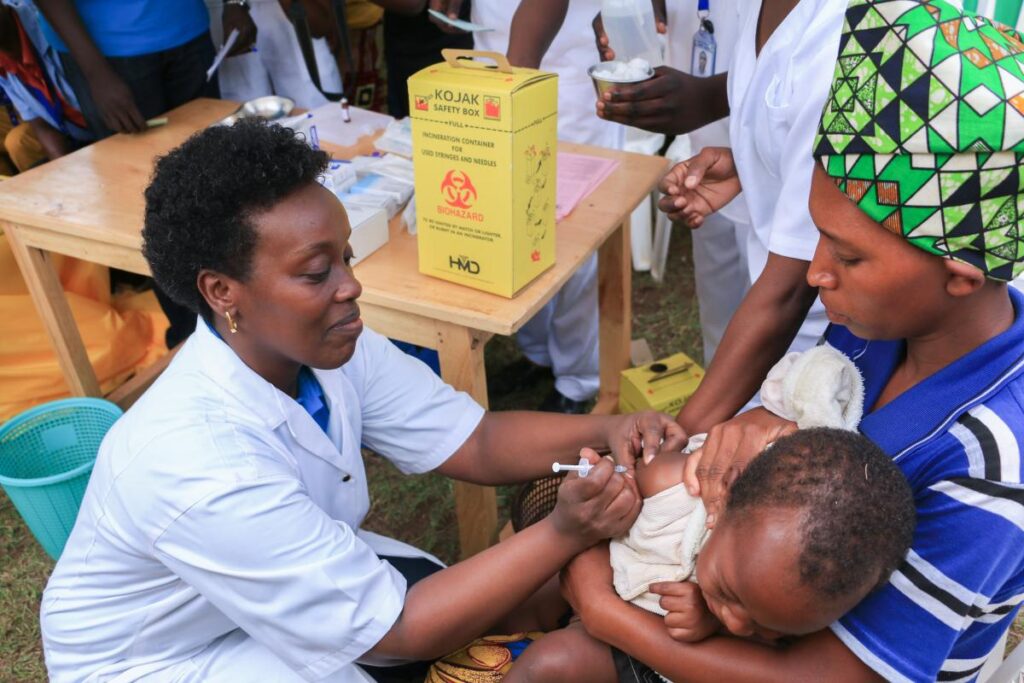
- Rapid Response Clinics & United Logistics. United Logistics manages a network of mobile clinics, refrigerated cargo drones and sheltered deployment modules. The company uses HTC smart contracts to reserve lift capacity, automate customs clearing, and execute payments to local partners upon verified delivery.
- Local integration. United Vitalis works with ministries of health to map existing immunisation networks, then overlays AI-generated demand forecasts and micro-supply plans to close gaps.
These layers reduce traditional bottlenecks and improve vaccine equity. For example, United Vitalis’s targeted campaigns in regions with sparse cold chain capacity rely on thermostable formulations plus drone last-mile delivery to village nodes where micro-clinics operate.
Adaptive dosing and biosensor feedback loops
A defining capability is closed-loop therapy: medicines that adjust to the patient as they live with the drug.
Mechanism (conceptual):
- Wearable and implantable biosensors track relevant biomarkers (e.g., cytokine signatures, serum drug levels) and transmit encrypted aggregates to local edge nodes.
- Gabriel evaluates biomarker trajectories using validated PK/PD models. If thresholds cross, the system issues dosing recommendations to clinicians or triggers on-device microdosing in approved systems.
- For population programs, aggregate data refine booster schedules and public-health guidance without exposing identifiable records.
This approach reduces adverse events, improves efficacy and supports personalised prophylaxis—all while preserving privacy through federated analytics and differential privacy techniques.
Regulatory, ethical and compliance framework
Operating at this scale requires rigorous compliance.
United Vitalis’s governance pillars:
- Regulatory alignment. The company maps workstreams to ICH E6 (GCP), ICH Q10 (Quality System) and EU/US regulatory expectations for clinical evidence. It engages early with agencies for adaptive trial designs.
- Quality and manufacturing standards. Regional facilities meet GMP and ISO 13485 for device-linked therapies and diagnostics. Quality operators use continuous manufacturing metrics and digital QA signatures.
- Data privacy and sovereignty. United Vitalis stores national health data on locally jurisdictional enclaves, with zero-knowledge proofs where cross-border verification is required. The platform supports GDPR-equivalent controls and local data residency.
- Ethics and community consent. The company uses community advisory boards, independent ethics review, and transparent benefit-sharing agreements, particularly when working in low-resource settings.
United Vitalis publishes redacted after-action and safety reports and invites third-party audits to build trust.
Financing, incentive models and Hashtag Coin (HTC)
To eliminate financial friction, United Vitalis integrates HTC as a procurement and incentive layer.
How HTC works in this context:
- Governments, donors and private actors can pre-purchase vaccination credits denominated in HTC. Those credits reserve manufacturing slots and distribution capacity.
- Local clinics and community health workers earn micro-payments in HTC for verified immunisations and surveillance tasks, creating sustainable incentive systems.
- Importantly, HTC holdings tie to resource-backed reserves audited on LME-linked ledgers, offering a stable settlement mechanism for cross-border procurement.
United Vitalis designs these flows to comply with financial regulation and to provide auditable trails for donors and partners.
Case studies (high-level summaries)
Rapid pandemic response (pilot scenario). Within weeks of detecting a novel respiratory pathogen signature, Gabriel model ensembles prioritised antigenic targets. United Vitalis progressed a thermostable vaccine candidate into adaptive Phase 1/2 trials that used virtual cohort stratification to select representative subpopulations. Parallel micro-manufacturing scaled regional fills while United Logistics staged mobile clinics in high-risk corridors.
Precision immunotherapy for autoimmune disease (clinical pathway). Gabriel-augmented drug discovery prioritised an immunomodulator optimized for a genetically stratified cohort. Paired biosensor monitoring allowed tailored dosing windows, reducing flare rates while improving response durability.
(These are conceptual summaries; operational details remain proprietary and regulated.)
Limits, risks and mitigation
United Vitalis recognises limits and openly mitigates them:
- Model bias and data gaps. The company invests in active dataset augmentation and third-party audits.
- Supply shocks. Modular manufacturing and multi-sourcing reduce single-point failures.
- Governance risk. Transparent governance, redacted audit access and public reporting aim to keep the project accountable.
Roadmap and vision
Near term, United Vitalis will expand regional micro-manufacturing footprints and certify additional adaptive formulations for thermostability. Over the medium term, the group plans regulated, integrated trials that embed biosensor-driven adaptive therapies into standard of care. Ultimately, Vision 64 frames a world where AI-guided medicines and tokenised logistics eliminate the vaccine inequity that has persisted for generations.
United Vitalis illustrates a new model for pharmaceutical science: one that treats discovery, formulation and delivery as a single engineered system rather than separate stages. By combining Gabriel AI’s predictive capabilities, modular nanoformulation, edge inference, distributed GMP production and tokenised logistics, GMU aims to cut timelines, lower cost and extend care to places historically excluded from rapid medical innovation. The result promises faster vaccines, smarter medicines and, importantly, a reproducible way to deliver them equitably at planetary scale—provided governance, ethics and technical rigour remain central at every step.